HELIA
- contact:
- funding:
BMFTR
- Partner:
Universitätsklinikum Würzburg (UKW), Forschungszentrum Jülich (FZJ), FZI Forschungszentrum Informatik, Karlsruher Institut für Technologie (KIT)
- startdate:
01.10.2025
- enddate:
30.09.2028
Development of a language-controlled mobile robot to assist clinical staff by combining knowledge-grounded task planning, reusable robot skills, and learning-based mobile manipulation.
Description
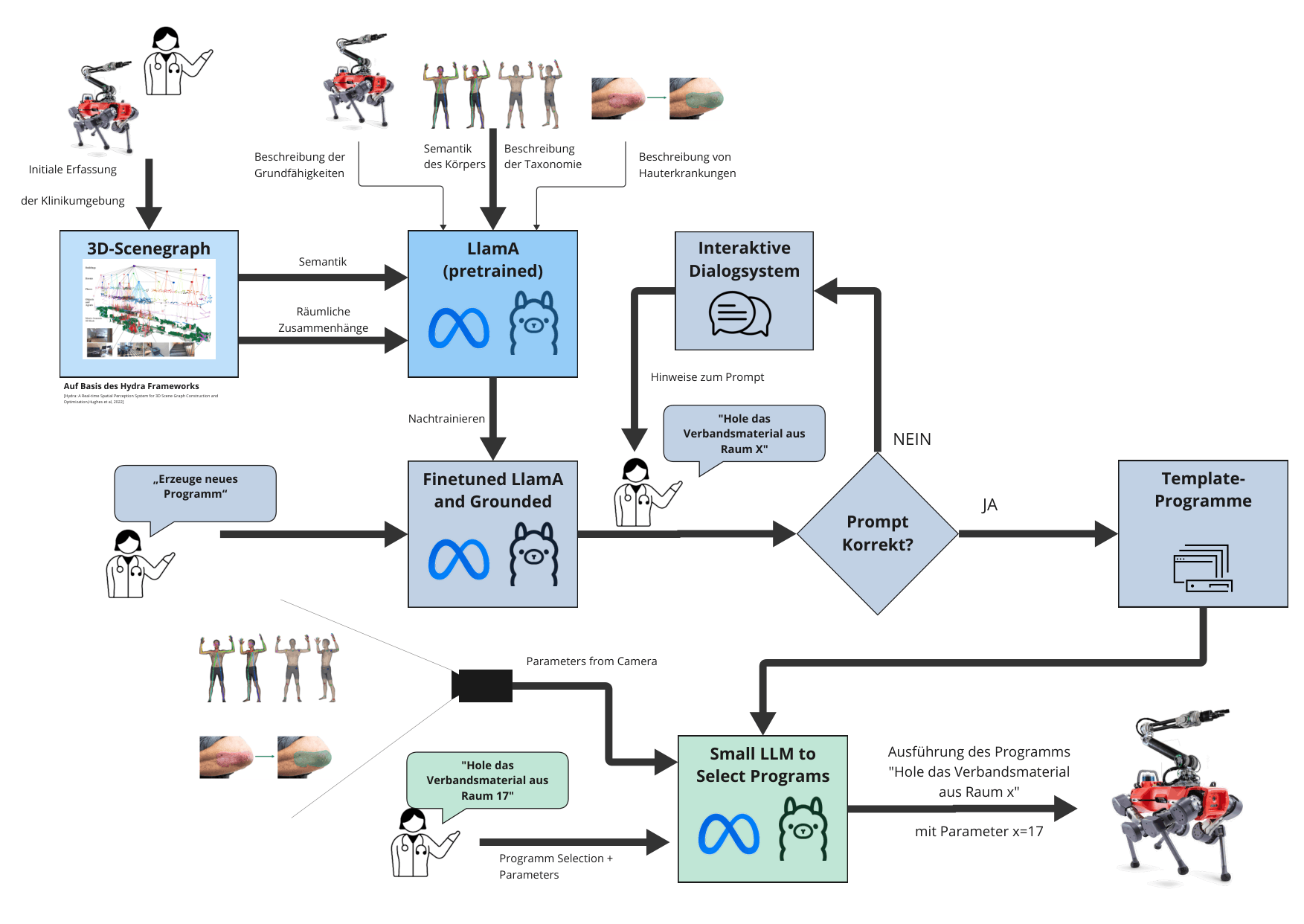
The HELIA project (Helfender Roboter im Klinikalltag) focuses on developing a mobile robot to assist clinical staff with recurring tasks, such as fetching and delivering objects and performing simple object-handling operations. The goal is to reduce staff workload and enable flexible, intuitive interaction between humans and robots in everyday clinical environments.
The project uses ANYmal D, a quadrupedal robot equipped with a robotic arm. This combination enables the robot not only to navigate different areas of a hospital but also to interact physically with objects and its surroundings. A central challenge is to reliably translate natural-language instructions into executable actions and carry them out safely in dynamic environments involving people, obstacles, changing object locations, and limited visibility. In addition, the robot must coordinate its locomotion and manipulation capabilities, particularly when tasks require joint control of the arm and body.
HELIA pursues a modular autonomy approach that combines knowledge-grounded task planning, reusable robot skills, and learning-based control methods. Large language models (LLMs) support the interpretation of instructions and the generation of executable task plans by incorporating environmental knowledge, available robot capabilities, and operational rules. Individual capabilities, such as navigation, locomotion, and grasping, are provided through well-defined interfaces and can be flexibly combined into new workflows. Multi-level monitoring verifies whether actions are permitted, individual skills are feasible, and tasks have actually been completed successfully.
The implementation combines conventional perception and planning methods with reinforcement-learning-based control and, prospectively, vision-language-action (VLA) models for manipulation. Robot skills are developed and tested in simulation before being transferred to and validated on the physical robot. Depending on the task, the system can rely on individual motion capabilities or employ whole-body control when coordination between the arm and body is required.
Through this approach, HELIA aims to enable clinical staff to specify tasks in natural language and combine existing robot capabilities into new workflows without having to program every task sequence individually. Developing new physical capabilities, however, still requires dedicated implementation, training, and validation.